



Working Days
Mon-Sat: 9.00 to 6.00
Is a Pharma Franchise Better Than a Medical Store Business?: There is extraordinary growth happening in India’s medical industry as the market is predicted to grow at a CAGR of around 9–11% in the years to come as a result of the rise of health awareness, aging population, rise of chronic diseases, and increased government support. In the same vein, the market for retail pharmacies is also continuing to expand, thus creating more opportunities for entrepreneurs wanting to enter the health sector.
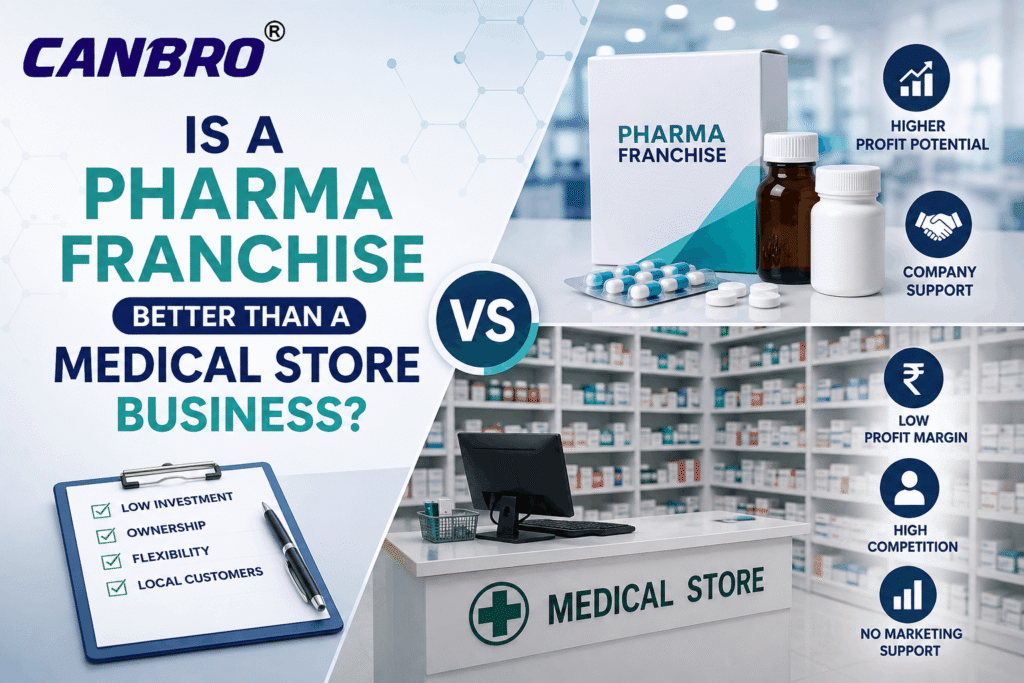
Pharma Franchise (PCD Pharma Franchise) and the Medical Store Business are two of the leading business options available today. Despite both belonging to the health sector and having great earning potential, there are considerable differences between them in terms of investment, operation, profit margin, licensing, and scaling. This knowledge should enable entrepreneurs to take an informed decision while investing as per their budget, experience and long-term goals.
Understanding a Pharma Franchise Business
The term Pharma Franchise refers to a specific kind of business model wherein a pharmaceutical company grants a partner the rights to market and distribute its products within the specified location. The franchise partners will be responsible for the promotion of medicines among hospitals, clinics, doctors, and chemists, thus being independent users of the products in question.
The main entity supplies product endorsements, promotional resources, assistance in marketing, and approved medicines, thus enabling affiliates to concentrate on enlarging their customer base as well as increasing revenue.
Key Features
- Low to moderate investment
- Monopoly rights in selected regions
- Large product portfolio
- Marketing support
- Promotional inputs
- Flexible business expansion
- No manufacturing responsibility
Understanding a Medical Store Business
A medical shop, which is also known as a retail pharmacy, is a facility that sells drugs to consumers either by prescription or over-the-counter. It acts as the ultimate connection point between pharmaceutical producers and customers.
To successfully run a medical store, one needs a commercial location, proper inventory management, licensed pharmacists, and adherence to regulatory requirements while ensuring sales on a daily basis.
Key Features
- Direct retail medicine sales
- Daily customer interaction
- Fixed business location
- Inventory management
- Prescription-based medicine dispensing
- Licensed pharmacist requirement
Pharma Franchise vs Medical Store Business
1. Investment Requirement
One of the biggest differences lies in the initial investment.
A Pharma Franchise generally requires comparatively lower investment because there is no need to purchase or rent expensive commercial retail space. Inventory can be managed according to demand, making the business suitable for new entrepreneurs.
A medical store demands higher investment due to shop setup, interiors, refrigeration, inventory, billing systems, licenses, and staff salaries.
2. Business Scalability
A Pharma Franchise provides remarkable scalability potential. Once the customer network grows, it will not be difficult for you to raise product orders and penetrate additional regions, assuming the company allows it.
It is common for medical stores to limit themselves to one physical location. To expand, an opening of another location is necessary, thus increasing expenses considerably.
3. Profit Margin
Pharma franchise businesses usually earn attractive margins because medicines are purchased directly from pharmaceutical companies.
Medical stores also generate profits but operate on comparatively fixed retail margins influenced by market competition.
Franchise businesses often receive:
- Better distributor discounts
- Promotional schemes
- Bonus products
- Seasonal offers
4. Customer Base
Medical stores depend on walk-in customers and nearby residents.
Pharma franchise partners build relationships with:
- Doctors
- Hospitals
- Clinics
- Retail pharmacies
- Healthcare institutions
This creates recurring business opportunities and larger order values.
5. Daily Operations
Running a medical store involves:
- Managing customers
- Billing
- Inventory
- Expiry checks
- Staff supervision
- Prescription verification
A Pharma Franchise focuses more on business development, marketing, and client relationship management rather than retail operations.
6. Business Risk
Medical stores must store lots of items, which makes the creation of expired products and the accumulation of unsold products inevitable.
A lot of pharmaceutical franchise companies are providing stock replacement policies, promotional schemes, and better inventory planning, which reduces the capital risk involved.
Frequently Asked Questions (FAQ’s):
1. Is a pharma franchise business better than a medical store?
It depends on your goals, but a pharma franchise often offers higher growth potential with lower infrastructure requirements.
2. What is the main difference between a pharma franchise and a medical store?
A pharma franchise focuses on marketing and distributing products, while a medical store sells products directly to customers.
3. Which business requires a higher investment?
A medical store generally requires more investment due to shop setup, inventory, and licensing costs.
4. Which business has better profit margins?
A pharma franchise can provide attractive profit margins, especially with monopoly rights and a strong product portfolio.
5. Is a pharmacy license mandatory for a pharma franchise?
Requirements vary by business model and local regulations, so it’s important to check the applicable legal requirements.
6. Can beginners start a pharma franchise business?
Yes, many beginners choose this business because it offers flexible investment options and growth opportunities.